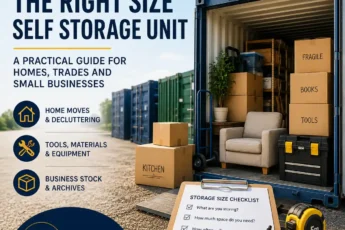


Moving house should be exciting, but the practicalities of getting everything from one property to another can quickly become complicated. Completion dates do not always line up, downsizing can leave you with more furniture than you have room for, and trying to pack an entire home while still living in it can make the process considerably harder.
Self storage can provide a useful buffer between your old home and your new one. Instead of trying to coordinate every item of furniture and every box around a single moving day, you can move possessions into secure storage gradually and retrieve them when you are ready.
For people moving home in Cheltenham, Tewkesbury, Winchcombe, Evesham and the surrounding Gloucestershire area, William Gilder Group provides secure self storage at Toddington, offering a practical option for both short- and longer-term storage.
How can self storage help when moving house?
Using self storage when moving house gives you somewhere secure to keep furniture, boxes and other possessions temporarily.
Rather than treating moving day as the point when everything has to transfer from one property to another, storage allows you to divide the move into more manageable stages.
It can be particularly useful when:
- your sale and purchase completion dates do not coincide;
- you are moving into temporary accommodation;
- you are downsizing;
- your new property needs decorating or renovation;
- you want to declutter before putting your current home on the market;
- you are moving gradually rather than using a single removal day; or
- you simply want fewer boxes and pieces of furniture to deal with on moving day.
The result is greater flexibility over when possessions leave your old property and when they arrive at the new one.

Using self storage before putting your house on the market
Self storage can be useful well before moving day.
Over time, most homes accumulate furniture and belongings that are useful to their owners but can make rooms appear smaller or more crowded when photographed for an estate agent or viewed by prospective purchasers.
Temporarily storing some of these possessions allows you to declutter without having to dispose of things you want to keep.
You might consider storing surplus furniture, seasonal items, books, sports equipment, boxed possessions and other belongings that you are unlikely to need before the move.
It also has another advantage: you have already started packing.
When a buyer is found and moving day approaches, some of the work has therefore been completed in advance.
What if your moving dates don’t match?
A gap between leaving one property and gaining access to another can create an obvious problem: where does everything go?
You may be able to stay with relatives, rent temporary accommodation or book a hotel, but moving the contents of an entire house with you is rather less practical.
A self-storage unit provides somewhere to keep your possessions during the gap.
Furniture and packed belongings can be moved from your existing home into storage and then collected once you have the keys to your new property.
This can be particularly helpful when you are part of a property chain and circumstances outside your control affect the timing of your move.
Self storage when downsizing
Moving to a smaller home often means deciding what will fit before you have had an opportunity to live in the new property.
There is no need to make every decision immediately.
Putting some furniture and possessions into storage gives you time to determine what you actually need in your new home. Once you have settled in, you can decide whether stored items should be brought back, sold, donated or passed to family members.
That can be preferable to getting rid of possessions before the move and later discovering that you had room for them after all.

Storage while renovating your new home
Getting the keys does not necessarily mean your new house is ready for all your possessions.
You may want to decorate, replace flooring, remodel a kitchen or bathroom, or undertake more extensive renovation work before fully moving in.
Keeping furniture and boxes in storage can make this work easier. Contractors have more room to operate, possessions are kept away from dust and decorating work, and you avoid repeatedly moving furniture from one room to another.
You can then bring your possessions into the house progressively as individual rooms are completed.
What can you put into self storage when moving house?
Self storage can accommodate many of the possessions normally associated with a house move, including furniture, boxed household goods and other suitable belongings.
A useful approach is to divide everything into three categories:
Keep with you – important documents, medication, valuables, chargers, clothing and everything you will need immediately.
Move directly to your new home – essential furniture and household items you know you will need straight away.
Put into storage – possessions you want to keep but will not require immediately.
Labelling boxes clearly will save considerable time later. Instead of simply writing “household” or “bedroom”, use more specific descriptions such as “Kitchen – pans and baking equipment” or “Bedroom – winter clothes”.
How much self storage do you need?
This depends on how much of your home you intend to store.
William Gilder Group’s self-storage units at Toddington are 20ft × 8ft, providing approximately 160 sq ft of storage space. This provides substantial capacity for furniture and boxed household possessions.
Making efficient use of the space is important. Furniture that can be safely dismantled will occupy less room, while sturdy boxes can be stacked to make use of the unit’s height.
Think about accessibility as well as capacity. If everything will remain in storage until one final collection, you can concentrate on using the available space efficiently. If you expect to retrieve individual possessions periodically, leave a sensible route through the unit rather than packing everything tightly from front to back.
How should furniture be prepared for storage?
A little preparation can help protect furniture while it is stored.
Empty cupboards and drawers before moving them and, where practical, dismantle larger pieces of furniture. Keep screws, fixings and assembly instructions together and label them so that rebuilding furniture at the other end is straightforward.
Clean and dry items before putting them into storage. Protective covers can be used for suitable furniture, while fragile items should be wrapped carefully and packed so they cannot move or be crushed.
Avoid making boxes unnecessarily heavy. Books, for example, are better distributed between several smaller boxes than packed into one large container that is difficult to lift.
Why drive-up self storage can make moving easier
Access becomes particularly important when you are loading or unloading large quantities of possessions.
The William Gilder Group storage facility uses drive-up storage units, allowing you to take your vehicle directly to your unit rather than carrying furniture and boxes through corridors or between different floors.
That can make a significant difference when loading bulky furniture, multiple boxes or heavier household items.
It is also useful if you intend to move possessions gradually. Instead of arranging one large transfer, you can bring suitable items into storage as you pack them and reduce the amount remaining in the house as moving day approaches.
Choosing secure self storage near Cheltenham
Security is naturally an important consideration when possessions may remain away from your home for weeks or months.
William Gilder Group provides secure, weatherproof self-storage units at its Toddington facility, conveniently positioned for customers from Cheltenham and the surrounding Gloucestershire area.
The site has 24/7 CCTV monitoring, while the units provide dry, secure storage for suitable household possessions.
Its location makes it an option for people looking for self storage around Cheltenham, Tewkesbury, Winchcombe and Evesham, without having to travel into the centre of Cheltenham each time they need to visit their unit.
When should you book self storage for a house move?
If you know that you are likely to need storage, it is worth arranging it before moving day.
Booking early gives you the opportunity to pack and move possessions gradually rather than trying to transfer everything at once.
A practical sequence might be:
- Declutter the house and identify items for storage.
- Pack possessions that you will not need before moving.
- Move these into your storage unit.
- Pack the remaining non-essential items as completion approaches.
- Keep only moving-day essentials at home.
- Move into the new property.
- Retrieve stored possessions as and when you need them.
This turns a single large move into several smaller, more manageable stages.
Self storage near Cheltenham from William Gilder Group
William Gilder Group provides secure and flexible self storage at Toddington in Gloucestershire, with convenient access from Cheltenham and surrounding towns.
The facility offers:
- 20ft × 8ft storage units with approximately 160 sq ft of space
- Drive-up access
- Secure, weatherproof containers
- 24/7 CCTV monitoring
- Flexible storage periods
- Convenient access for Cheltenham, Tewkesbury, Winchcombe and Evesham
- Prices from £25 + VAT per week
Whether you need somewhere to keep possessions for a few weeks between completion dates or require storage for longer while you renovate or settle into a new property, self storage can remove some of the pressure from the moving process.
Find out more about secure self storage near Cheltenham or contact William Gilder Group to discuss availability.
Frequently Asked Questions
Is self storage useful when moving house?
Yes. Self storage gives you somewhere to keep furniture, boxes and other suitable possessions before, during or after a house move. It can be particularly useful if completion dates do not coincide, you are downsizing, moving into temporary accommodation or carrying out work on your new property.
When should I book self storage before moving house?
It is sensible to arrange storage as soon as you know you will need it. Having access to your unit before moving day allows you to declutter and move non-essential possessions gradually rather than trying to move everything at once.
Can I use self storage if there is a gap between house moves?
Yes. Temporary self storage can bridge the gap between leaving your existing property and moving into your new home. Your furniture and other possessions can remain in storage until the new property is available.
How much space does a 20ft storage container provide?
William Gilder Group’s storage units measure approximately 20ft × 8ft and provide around 160 sq ft of storage space. How much you can accommodate will depend on the size and shape of your furniture, how items are packed and whether larger pieces can be dismantled.
Can I store furniture while renovating my new house?
Self storage can be particularly useful during renovation or decorating work. Keeping suitable furniture and boxed possessions away from the property gives tradespeople more working space and allows you to bring belongings back as rooms are completed.
Where can I find self storage near Cheltenham?
William Gilder Group operates secure self-storage units at Toddington, Gloucestershire, providing a convenient option for people travelling from Cheltenham, Tewkesbury, Winchcombe, Evesham and surrounding areas.